Table Of Contents
- Why Active Learning Works for Young Children
- How Hands-On Activities Build Confidence
- Ways to Keep Curiosity at the Center
- Skills Children Practice Through Exploration
- What Strong Learning Environments Include
- Simple Activities Families Can Try at Home
- How Adults Can Offer Support Without Taking Over
- Common Questions From Parents and Educators
- A Practical Path Forward
Young children learn by doing. In Fairfax County, VA, that can mean observing a squirrel during a neighborhood walk, testing which objects float in a kitchen sink, building a bridge from recycled paper, or retelling a favorite story with a new ending. These moments help children connect ideas to real experiences while practicing focus, communication, and persistence.
Families considering private elementary schools in Fairfax County, VA, may look for learning environments that give children meaningful opportunities to ask questions, use materials, and explain their thinking. Active learning does not require a complicated project every day. It starts with a clear purpose, a few useful tools, and enough time for children to explore.
Why Active Learning Works for Young Children
Active learning means children are involved in the learning process. Instead of only hearing an answer, they can touch, move, sort, test, draw, build, compare, and discuss. A science investigation, art project, reading game, outdoor observation, or block structure can all become active learning when children have a goal and a chance to make choices.
The activity itself is not enough. Busywork keeps hands occupied, while purposeful exploration gives children a reason to think. For example, coloring a picture of a bridge is different from designing a paper bridge that can hold several small objects. The second activity invites planning, testing, revision, and conversation. This approach aligns with play-based, joyful, and engaged learning that responds to children’s strengths, interests, and stages of development.
Adults still matter. They create safe boundaries, introduce useful vocabulary, organize materials, and ask questions that help children notice what is happening. The aim is not to leave children alone with supplies. It is to offer guidance without removing the challenge.
How Hands-On Activities Build Confidence
Children gain confidence when they can see the connection between effort and progress. A tower that stands, a puzzle piece that fits, or a seed that begins to sprout can show a child, “I tried something, and it worked.” Even when the first attempt fails, the child has a concrete starting point for trying again.
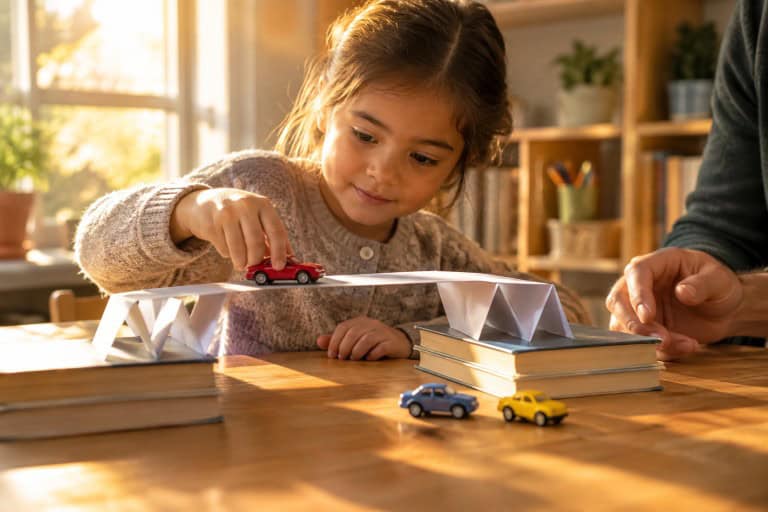
Consider a child whose paper bridge collapses under the weight of toy cars. An adult can avoid immediately fixing it and instead ask, “What part bent first?” The child may fold the paper, add a support, or use a wider base. The redesigned bridge may still be imperfect, but the child has practiced flexible thinking and learned that setbacks can provide useful information.
Specific encouragement is more helpful than general praise. Comments such as “You kept testing different shapes,” “You noticed the tape was coming loose,” and “You listened to your partner’s idea” recognize the behaviors that support learning.
Ways to Keep Curiosity at the Center
Curiosity grows when children feel their observations and questions matter. Adults do not need to turn every walk, meal, or bath into a formal lesson. A short conversation can be enough: “What do you notice?” “What do you think will happen?” “What changed?” and “What could you try next?”
In Fairfax County, changing seasons offer easy prompts for observation. Children can compare fallen leaves by size and texture, listen for different sounds after rainfall, or notice how a sunny and shaded area feels different. Give a child time to investigate before supplying an answer. A pause communicates that thinking is worthwhile.
Mistakes should be treated as clues. If an experiment does not produce the expected result, children can describe what happened, adjust one part of the plan, and test again. That process supports sustained attention because the next step belongs to the child.
Skills Children Practice Through Exploration
Well-designed hands-on experiences can support many areas of early development at once:
- Problem-solving: Children compare choices, test solutions, and revise plans.
- Language: They use words to describe materials, actions, predictions, and results.
- Early math: Sorting buttons, counting steps, measuring water, and spotting patterns bring number concepts into everyday play.
- Science thinking: Children observe closely, make predictions, investigate, and explain what they notice.
- Motor skills: Pouring, stacking, cutting, drawing, rolling clay, and using tongs strengthen coordination.
- Social skills: Shared projects require children to listen, take turns, negotiate roles, and solve small disagreements.
- Self-regulation: Waiting for glue to dry, returning to a difficult task, and cleaning up materials provide practice with patience and responsibility.
What Strong Learning Environments Include
Effective learning spaces balance structure with choice. Predictable routines help children know what to expect, while open-ended materials such as blocks, clay, cardboard, paper tubes, water, natural objects, and loose parts invite more than one possible answer. A quiet area can also help children reset when a busy group activity becomes overwhelming.
Educators can adjust the level of challenge without changing an activity’s purpose. One child may sort leaves by color, while another measures and records their lengths. Displaying children’s work, photographs, and dictated explanations also shows that process matters, not only the finished product. Local families can extend this approach through hands-on early childhood programs that include creative play, art, science, outdoor experiences, and social interaction.
Simple Activities Families Can Try at Home
- Paper Bridge Challenge: Provide paper, tape, and a few small objects. Ask the child to build a bridge that holds weight, then improve it after each test.
- Sink or Float Test: Gather safe household objects. Before placing each one in water, ask the child to predict whether it will sink or float and explain why.
- Shape Hunt: Search for circles, rectangles, triangles, and curves around the home, grocery store, or neighborhood.
- Story Remix: Read a familiar book, then invite the child to create a different setting, problem, or ending.
- Nature Collection: Gather fallen leaves, small stones, or twigs, then sort them by color, size, texture, or shape.
- Sound Search: Sit quietly for one minute and identify sounds that are loud, soft, high, low, near, or far away.
How Adults Can Offer Support Without Taking Over
It can be tempting to step in as soon as a child becomes frustrated. Often, a brief wait gives the child space to think. Instead of providing the answer, offer a small prompt: “What have you tried?” “Which part is working?” or “What material could help?” Keep safety rules clear, but allow reasonable experimentation and accept that children may reach a result that differs from the adult’s original expectation.
Common Questions From Parents and Educators
Does Hands-On Learning Replace Direct Teaching?
No. Direct teaching and active learning work well together. A child may need a short demonstration, a new word, or clear instructions before beginning an investigation.
What If a Child Loses Interest Quickly?
Shorten the activity, add movement, change the materials, or connect the task to something the child already enjoys. A meaningful challenge is more likely to hold attention than an activity with no clear purpose.
How Can Adults Notice Progress?
Look beyond a finished product. Progress may appear as better questions, longer concentration, more detailed explanations, improved cooperation, or greater willingness to try again after a setback.
Can Activities Be Adapted for Different Needs?
Yes. Adults can use larger materials, visual directions, fewer steps, extra time, movement breaks, or peer support while keeping the central learning goal intact.
A Practical Path Forward
Young children do not need constant entertainment or expensive kits to learn well. They need meaningful questions, caring guidance, useful materials, and time to test their ideas. In homes and learning spaces across Fairfax County, active learning can help children build knowledge while also developing confidence, persistence, communication, and curiosity.