Key Takeaways
- There is rarely one automatic answer in a multi-car pileup because each impact may have a different cause.
- The driver or drivers found responsible for causing damage generally have liability coverage that may cover others’ claims up to the policy limits.
- Your own collision coverage may pay for your vehicle repairs first, less your deductible, while insurers investigate fault.
- Injury claims may follow different rules than vehicle-damage claims, especially in no-fault states.
- Photos, witness accounts, vehicle damage, police reports, and video can all matter when insurers reconstruct a chain-reaction crash.
A multi-car pileup can turn a simple insurance question into a complicated investigation. One vehicle may start the chain reaction, another driver may fail to stop in time, and several cars may sustain damage from separate impacts. If you are trying to understand your options after a serious collision, Dimopoulos Law car accident attorneys can help explain how fault evidence and available insurance coverage may affect a claim.
The short answer is that the at-fault driver’s liability insurance often pays for damage they caused, but a pileup can involve multiple at-fault drivers and multiple insurance policies. Your own policy may also provide a faster route to repairs, depending on whether you carry collision coverage and the terms of your policy.
Why Multi-Car Pileups Are Different
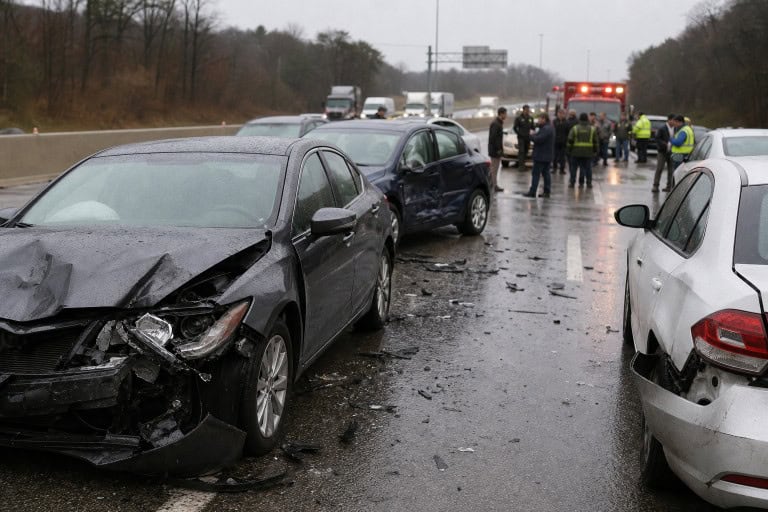
In a two-car crash, the central question may be who caused the impact. In a pileup, insurers need to determine the sequence of events. For example, Driver A may rear-end Driver B, pushing B into Driver C. Later, Driver D may strike the already-disabled vehicles because of an unsafe following distance. Each driver may be responsible for different types of damage.
That means the insurance company may not treat the entire incident as the responsibility of a single person. Adjusters commonly review statements, photographs, roadway conditions, traffic-camera footage, dashcam recordings, vehicle damage patterns, and the police report. A report can be important evidence, but it does not necessarily make the final insurance decision on fault.
How Liability Insurance Usually Applies
Liability coverage is designed to pay for injuries and property damage caused by an insured driver to others. In a pileup, the insurer for a driver who caused the impact may pay for repairs, rental expenses, medical losses, or other covered damages resulting from that impact. As basic auto insurance coverage rules explain, property-damage liability is intended to cover damage an at-fault driver causes to another person’s vehicle or property.
However, liability coverage has limits. If one driver causes extensive damage to several vehicles, the available property-damage limit may not be enough to cover every claim in full. When that happens, claimants may need to rely on their own collision coverage, pursue other responsible parties, or explore uninsured and underinsured motorist property damage coverage where available.
One Driver Caused the Entire Chain Reaction
If one driver was clearly responsible, such as a driver who was speeding, distracted, or following too closely before striking a line of stopped cars, that driver’s liability insurer may be responsible for the resulting losses. Even then, the insurer will usually investigate before accepting responsibility and determining the amount payable.
Several Drivers Made Separate Mistakes
Shared fault is common in a pileup. One driver may trigger the initial crash, while another may contribute by driving too fast in rain, fog, ice, or heavy traffic. Depending on state law and the available evidence, insurers may assign percentages of fault. Those allocations can affect who pays and how much each insurer contributes.
When Your Own Collision Coverage Pays
Collision coverage generally pays to repair or replace your vehicle after it collides with another vehicle or object, regardless of who ultimately caused the crash. Filing through your own insurer can be useful when fault is disputed, the other driver has not been identified, the other insurer is slow to respond, or the at-fault driver has insufficient coverage.
You will usually be responsible for your deductible at first. If your insurer later recovers money from an at-fault driver’s insurer through subrogation, it may seek to recover your deductible as well. Recovery is not guaranteed, especially when liability is divided or the responsible party has limited insurance.
What About Injuries, Medical Bills, and Lost Income?
Vehicle repairs and injury claims do not always follow the same path. In some states, personal injury protection or medical payments coverage may pay certain medical expenses under your own policy. In other states, an injured person may pursue the at-fault driver’s bodily injury liability coverage. Rules about no-fault benefits, lawsuits, comparative negligence, and deadlines vary significantly by state.
It is important to seek prompt medical attention when symptoms appear. Pain, dizziness, headaches, numbness, and soft-tissue injuries can develop after the initial shock of a collision. Keep records of appointments, bills, prescriptions, work absences, and the effects of injuries on daily activities.
What If an Uninsured Driver Caused the Pileup?
An uninsured driver can create another layer of difficulty. Depending on your state and policy, uninsured or underinsured motorist coverage may help with injury losses and, in some places, vehicle damage. Coverage availability, exclusions, deductibles, and limits vary. The National Association of Insurance Commissioners notes that uninsured and underinsured motorist coverage can help when an at-fault driver lacks enough insurance to cover a loss.
If a driver leaves the scene, treat the crash as a possible hit-and-run. Call law enforcement, quickly preserve the video, photograph the debris and damage, and notify your insurer without delay. A quick report may be required for certain coverages.
Steps to Take After a Multi-Car Crash
- Move out of immediate danger if it is safe to do so, turn on the hazard lights, and call 911 if there are injuries, blocked lanes, a fire, or other hazards.
- Exchange names, contact details, driver’s license information, insurance information, license plate numbers, and vehicle descriptions with every involved driver.
- Photograph the full scene before vehicles move, including vehicle positions, damage, debris, lanes, signals, weather, and skid marks.
- Get names and contact details for witnesses, and ask whether nearby businesses or vehicles may have video footage.
- Notify your insurer promptly, provide accurate facts, and avoid guessing about speed, distance, or fault.
- Save towing bills, repair estimates, rental receipts, medical records, and all claim communications in one file.
Common Mistakes That Can Complicate a Claim
- Admitting fault at the scene before the full sequence of impacts is known.
- Failing to photograph all vehicles, especially cars, further down the chain.
- Assuming the police report alone resolves every insurance dispute.
- Waiting too long to notify an insurer or report a hit-and-run.
- Accepting a settlement before understanding whether it releases all future claims.
- Repairing or disposing of the vehicle before documenting the damage and receiving the insurer’s instructions.
Final Thoughts
In a multi-car pileup, insurance payment usually follows fault, available coverage, and the specific damage caused by each impact. The responsible driver’s liability insurance may cover the costs, but more than one insurer may be involved. Your own collision coverage can provide an important backup while responsibility is still being investigated. Careful documentation, prompt reporting, and a clear understanding of your policy can make the process more manageable.